


Palmitoleic acid: an omega-7 fatty acid with a unique profile
Palmitoleic acid, or cis-9-hexadecenoic acid (C16:1), is a monounsaturated fatty acid belonging to the omega-7 family. Its chemical formula is C₁₆H₃₀O₂, with a molar mass of 254.4 g/mol. Unlike omega-3 and omega-6 fatty acids, the human body can synthesize it. It is found in all tissues, with particularly high concentrations in the liver and adipose tissue. But what makes it fascinating is its role in the skin. Palmitoleic acid accounts for more than 20% of the fatty acids in human sebum, according to data from cosmetologist Michel Sabadie, a graduate of the École Supérieure d’Application des Corps Gras and former vice president of R&D at Shiseido International. It forms a protective film on the surface of the epidermis, slows dehydration, and contributes to the skin’s antimicrobial self-defense. In 2008, research by Cao, Gerhold, and Mayers identified palmitoleic acid as the first known lipokine: a lipid hormone linking adipose tissue to systemic metabolism. In other words, this unsaturated fatty acid does more than just nourish the skin. It orchestrates communication between the fat and muscle tissues in your body.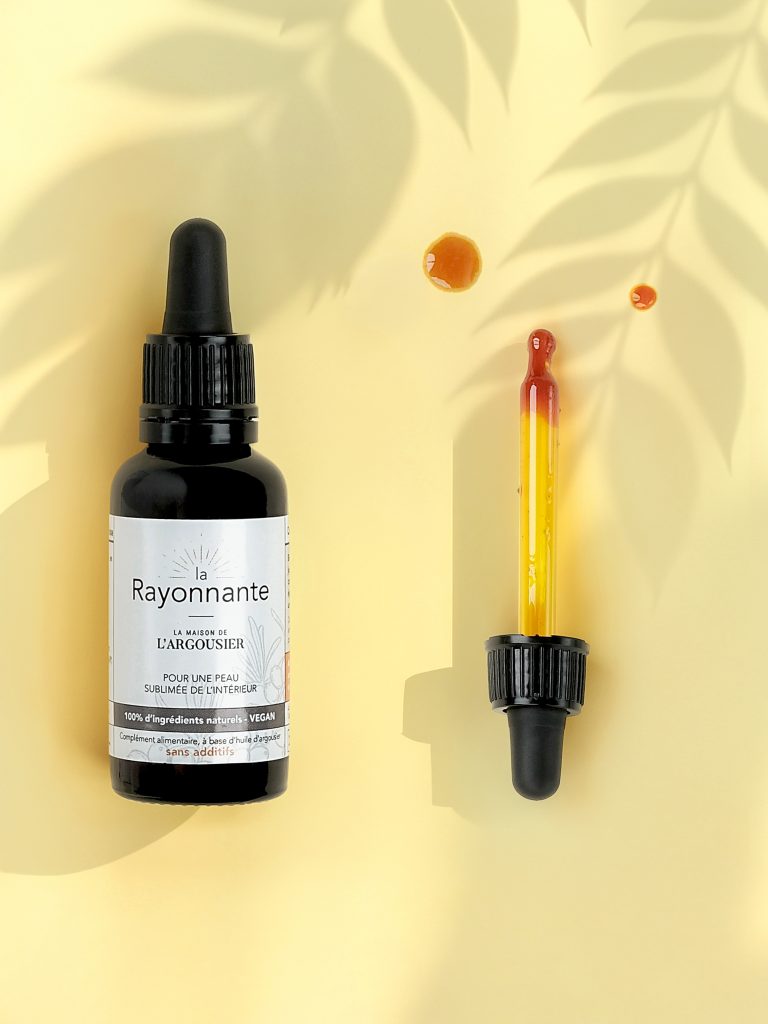
The Benefits of Palmitoleic Acid for the Skin
Long overshadowed by omega-3 and omega-6 fatty acids, palmitoleic acid is beginning to step out of the shadows. Recent research on its role as a lipokine and its effects on mucous membranes has reignited scientific interest in this molecule. To better understand the recognized benefits of omega-7, we have dedicated a comprehensive feature to this fatty acid, which remains largely unknown to the general public.
L’acide palmitoléique appartient à la grande famille des omégas, qui regroupe les oméga-3, 6, 7 et 9. Chacune de ces sous-familles remplit des fonctions distinctes dans l’organisme : protection cardiovasculaire, maintien du film hydrolipidique, confort des muqueuses ou action anti-inflammatoire. Comprendre leurs différences permet de mieux cibler ses apports, que ce soit par l’alimentation ou par une supplémentation adaptée.
Why does the skin love this omega-7? Because it’s just like the skin itself. Sea buckthorn oil, whose fatty acid composition most closely resembles that of human sebum, is naturally rich in palmitoleic acid (30 to 40% of its fatty acids). This biomimetic quality explains its remarkable skin tolerance. Specifically, palmitoleic acid helps to:- Moisturizes without leaving a greasy residue: its film-forming properties help prevent skin dehydration while regulating the hydrolipidic film.
- Protecting against infections: A study by Wille and Kydonieus (Skin Pharmacol Appl Skin Physiol, 2003) demonstrated in vitro that palmitoleic acid has antimicrobial activity against Gram-positive skin bacteria. Yamamoto et al. (J Oleo Sci, 2015) confirmed its bactericidal effect against Staphylococcus aureus and Propionibacterium acnes.
- Promotes healing: this fatty acid aids in the epithelialization and repair of superficial skin tissue (scrapes, minor burns).
- Supporting mature skin: The body’s natural production of palmitoleic acid decreases with age, contributing to the skin’s gradual thinning and dryness. External application helps compensate for this loss.
Palmitoleic acid and mucous membranes: restored comfort
Omega-7 fatty acids, particularly palmitoleic acid, are known for their beneficial effects on mucous membranes. Dry eyes, mouth, vagina, and digestive tract: these discomforts affect many women, especially after menopause. The review by Solà Marsiñach and Cuenca (Lipids in Health and Disease, 2019) compiles several clinical studies on the subject. One of these studies involved 116 postmenopausal women randomized into two groups: one supplemented with sea buckthorn oil (containing 24% palmitoleic acid), the other receiving a placebo, for 3 months. The results indicate a positive trend in the vaginal health index in the sea buckthorn group, without an increase in circulating estrogen levels. A promising avenue for women seeking a natural alternative. Omega-7s also contribute to the hydration of the ocular mucous membranes. Larmo et al. (J Nutr, 2010) observed that oral supplementation with sea buckthorn oil reduced the osmolarity of the tear film and symptoms of dry eye. La Maison de l’Argousier has formulated La Rayonnante specifically to meet these needs. This dietary supplement combines organic sea buckthorn oil, which is naturally rich in palmitoleic acid, with coenzyme Q10, lutein, and vitamin E. A simple, 100% natural formula with just four ingredients, designed to support the mucous membranes, skin, hair, and nails.Metabolic Syndrome and Insulin Resistance: What the Research Says
Face à la sécheresse des muqueuses, tous les acides gras ne se valent pas. Les oméga-3 et 6 soutiennent l’organisme de façon globale, mais l’oméga-7 cible directement l’hydratation des tissus muqueux. Si vous hésitez entre plusieurs types de supplémentation, découvrez quel oméga choisir pour soulager les muqueuses sèches et pourquoi l’acide palmitoléique se distingue dans ce domaine précis.
L’acide palmitoléique n’est pas le seul acide gras proposé pour le confort des muqueuses. L’onagre et la bourrache, riches en GLA (oméga-6), sont souvent citées comme alternatives. Leur mode d’action diffère pourtant sensiblement de celui des oméga-7. Pour y voir plus clair, découvrez notre comparatif pour choisir entre oméga 7, onagre et bourrache selon votre situation.
Palmitoleic acid is not limited to beauty. As a lipokine, it acts as a messenger between adipose tissue and systemic metabolism. Research by Yang, Miyahara, and Hatanaka (Lipids Health Dis, 2011) showed that chronic administration of palmitoleic acid in type 2 diabetic mice (KK-Ay model) significantly reduced insulin resistance and hepatic lipid accumulation. The study by Souza et al. (J Cell Physiol, 2017) clarifies the mechanism: palmitoleic acid is thought to stimulate glucose uptake and inhibit lipogenesis in the liver by activating the AMPk and FGF-21 pathway, which is dependent on the PPAR-α receptor. These results were obtained in a mouse model and require confirmation in humans. Regarding cardiovascular effects, a controlled trial cited by Solà Marsiñach and Cuenca (2019) linked palmitoleic acid to a significant reduction in triglycerides and LDL cholesterol, as well as an increase in HDL in hyperlipidemic subjects, after 30 days of supplementation. Although preliminary, these findings hold great promise for the treatment of metabolic syndrome.Where can you find palmitoleic acid? Sea buckthorn, the undisputed champion
Very few plants contain significant amounts of omega-7. Sea buckthorn stands out distinctly for its high concentration. However, it is essential that the fatty acids are preserved during extraction. La Maison de l’Argousier uses an enzymatic process that involves no solvents or heat, which preserves the integrity of the palmitoleic acid and all the active compounds in the berry. The resulting oil contains both the pulp fraction (rich in omega-7) and the seed fraction (rich in omega-3 and 6), in the same proportions as found in the natural berry.Palmitoleic acid as a dietary supplement: what are the visible effects?
Can a dietary supplement rich in palmitoleic acid, taken orally, have an effect on the skin? The answer is yes, according to several converging lines of research. Palmitoleic acid circulates in the bloodstream and is distributed throughout all tissues, including the skin and mucous membranes. This is, in fact, the principle behind La Rayonnante: to provide omega-7 internally, as the skin produces less and less of it. Palmitoleic acid is perfectly compatible with other active ingredients such as vitamin C (found in native sea buckthorn water) or vitamin E.Palmitoleic acid vs. squalane: two complementary allies
Squalane, derived from plant sugars, is an emollient prized for its silky texture and its ability to strengthen the skin barrier. Palmitoleic acid, on the other hand, is a bioactive fatty acid that nourishes, protects, and regulates. These are two complementary approaches. Squalane mimics the skin’s surface lipids; while palmitoleic acid replicates the very composition of sebum. In fact, certain products from Maison de l’Argousier, such as Secret Sublimant, combine both: sea buckthorn oil (rich in palmitoleic acid) and 5–10% plant-based squalane. This synergy provides intense nourishment without leaving a greasy film.FAQ
Is palmitoleic acid good for your health?
Palmitoleic acid is an omega-7 fatty acid with numerous benefits. It helps nourish and protect the skin, moisturize the mucous membranes, and support metabolism. Research suggests it acts as a lipokine—a lipid hormone that facilitates communication between adipose tissue and muscles. Animal studies suggest beneficial effects on insulin resistance and lipid profile, but confirmation in humans is still pending.Does palmitoleic acid decrease with age?
Yes. The skin’s production of palmitoleic acid gradually declines with age. This decline contributes to dryness, fragility, and a loss of comfort in mature skin. External supplementation—either topically (through sea buckthorn oil skincare products) or orally (through dietary supplements such as La Rayonnante)—helps offset this natural decline.Does palmitoleic acid help with eczema or rosacea?
Omega-7 fatty acids, including palmitoleic acid, have anti-inflammatory properties and promote tissue regeneration. They are traditionally recommended to soothe sensitive, irritated, or eczema-prone skin. However, since every skin condition is different, a dermatologist’s advice is essential to tailor the treatment plan.Palmitoleic Acid at a Glance: A Treasure Long Overlooked
Palmitoleic acid is an omega-7 unsaturated fatty acid found naturally in human sebum. Its production decreases with age, making external supplementation necessary. Its benefits span a wide range: skin nutrition, antimicrobial protection, mucosal comfort, and metabolic support. Sea buckthorn, with 30 to 40% palmitoleic acid in its berry oil, is the richest plant source of this acid. La Rayonnante by Maison de l’Argousier harnesses this richness in a 100% natural formulation designed for the skin, mucous membranes, and vitality. The information provided is for informational purposes only and does not constitute medical advice. Consult your doctor or pharmacist.Sources and references
Palmitoleic acid isn’t just good for your skin and mucous membranes. It also nourishes the hair shaft by stimulating keratin production and regulating sebum on the scalp. If your hair lacks volume or shine, check out omega-7-based dietary supplements for hair and the active ingredients to combine with them for a truly effective treatment regimen.
L’huile d’argousier est bien tolérée par la majorité des utilisateurs, mais quelques situations méritent attention. Les personnes sous anticoagulants, celles sujettes aux calculs biliaires ou les femmes enceintes doivent consulter un professionnel de santé avant toute supplémentation. Pour faire le point sur les précautions à connaître avant une cure, nous avons détaillé les effets secondaires possibles, les interactions médicamenteuses et les contre-indications recensées à ce jour.
- Solà Marsiñach, M., and A.P. Cuenca, “The impact of sea buckthorn oil fatty acids on human health,” Lipids in Health and Disease, 2019, 18:145. DOI 10.1186/s12944-019-1065-9
- Michel T., “New Methods for Extraction, Fractionation, and Identification: Application to Bioactive Compounds from Sea Buckthorn (Hippophae rhamnoides),” Ph.D. thesis, University of Orléans, 2011. HAL tel-00677211
- Dubois V., Breton S., Linder M., Fanni J., Parmentier M., “Proposed classification of plant sources of fatty acids based on their nutritional profile,” OCL – Oilseeds and Fats, Crops and Lipids, 2008, 15(1):56-75. OCL link
- Internal data: Presentation by Michel Sabadie, MS Cosmetics Conseil – Fatty acid composition of sea buckthorn berry oil.


 Free shipping when you buy 2 or more items!